Wednesday, December 15, 2021


This stage is reserved for the individuals who expect to come out on the other side of a cataclysmic event. Preppers at this level have invested enormous amounts of time and money to be positioned to survive events capable of wiping out most of humanity. Underground shelters and compounds are being constructed around the globe, but these endeavors carry a price tag only a small percentage of the population can afford.
The extremes are well documented. People like Mark Zuckerberg can afford to spend hundreds of millions on a doomsday bunker in Hawaii. Other wealthy preppers purchase rooms in survival condos built inside decommissioned missile silos. From a prepper's perspective, everyone with that kind of wealth should be investing in long term survival preparations, and if you want your family to be part of the new civilization that follows a nuclear war or an asteroid impact, building wealth is a legitimate part of the strategy, because the wealthy are simply more likely to survive the end of days.
But extreme wealth is not the only path. Rural preppers, homesteaders and off grid preppers have quietly constructed long term living quarters stocked with essential supplies, choosing remoteness, hardened construction and self sufficiency over price tags. What unites this stage is not money but a time horizon measured in generations.
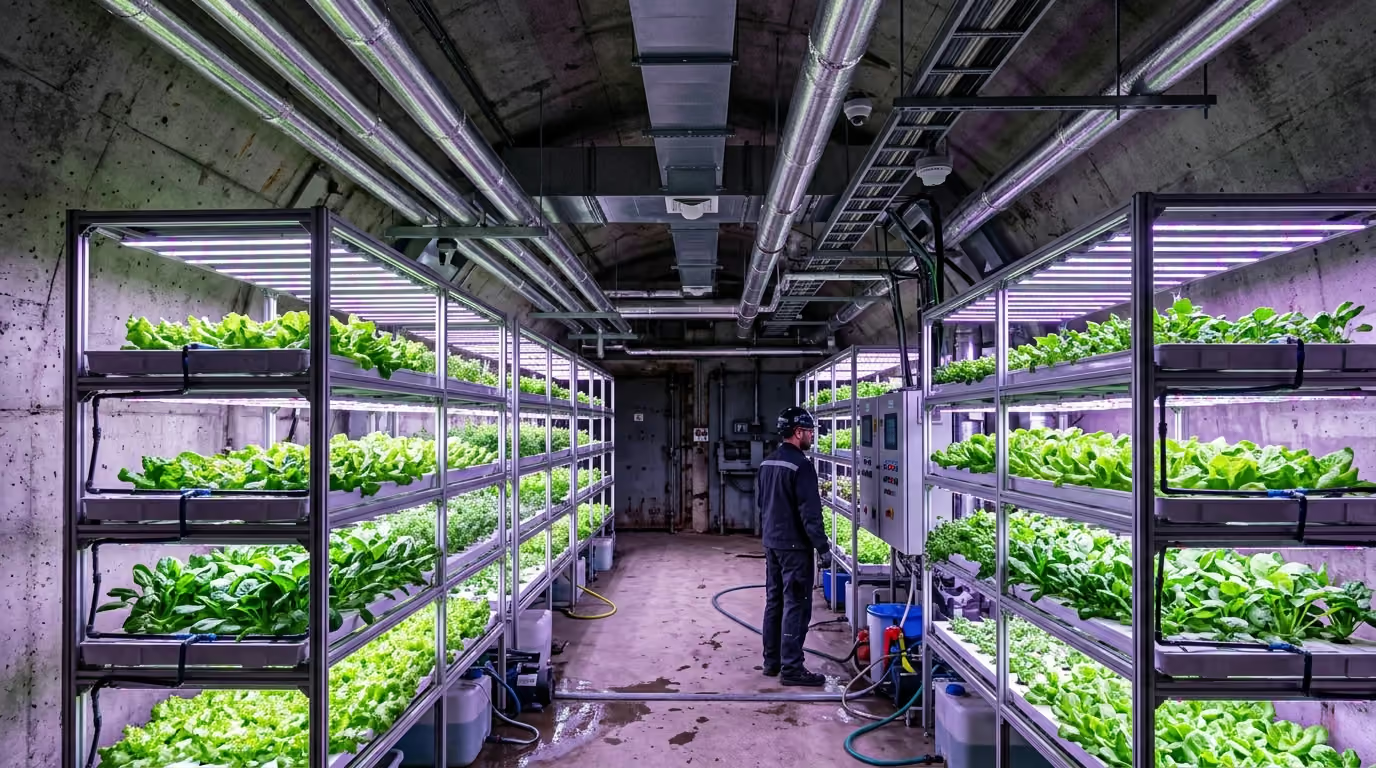
The new civilization stage is where preparedness stops asking how do I survive this and starts asking what comes after. These are the preppers who expect to walk out the other side of a cataclysmic event, and who have invested extraordinary amounts of time, money and land to make that possible. Their planning horizon is not seventy two hours or two winters. It is a generation. They are preparing not merely to endure the end of the world as we know it, but to be among those who rebuild something on the far side of it.
The scale here separates it from every stage before. Fully prepared preppers harden a homestead. New civilization preppers build hardened shelters, underground bunkers and self contained compounds designed to sustain life through nuclear war, asteroid impact, a genuine extinction level event, or the total and permanent collapse of the systems that support modern life. These builds carry air filtration and radiation shielding, independent power and water, food production capacity, medical facilities, and security measures intended to hold against a desperate world outside. They are, in effect, small arks.
They also carry a price tag that only a narrow slice of the population can reach. Underground shelters and compounds are under construction around the globe, financed by people for whom the cost is not a meaningful obstacle. Mark Zuckerberg can spend hundreds of millions on a doomsday bunker in Hawaii. Other wealthy preppers buy rooms in luxury survival condos built inside decommissioned missile silos, complete with hydroponic gardens, medical bays and armed staff. It is worth stating plainly what this implies. If you want your family to be part of the new civilization that follows a true cataclysm, obtaining wealth is a rational part of that strategy, because the wealthy are meaningfully more likely to survive the end of days. From a prepper's perspective, anyone with that kind of wealth should be investing some of it in long term survival preparation.
Yet the missile silo condo is not the only road, and it would be a mistake to conclude that this stage is closed to ordinary people. Rural preppers, homesteaders and committed off grid preppers have quietly built long term living quarters stocked with essential supplies, choosing isolation, hardened construction, water security and deep self sufficiency over eight figure budgets. Remoteness is a form of shielding. A defensible valley with a spring, arable land, a hardened root cellar and twenty years of practiced skill may serve a family better than a bunker they cannot reach when the roads close. What defines this stage is not the size of the investment but the length of the time horizon.
Thinking at this scale changes what preppers store. Beyond food, water, fuel and medicine, new civilization preppers store knowledge, tools and seed. They think about repopulation, about education, about preserving the technical understanding that would otherwise vanish within a generation. They think about governance and community structure, because a group that survives the event and then tears itself apart over the food supply has not really survived it. The prepper life at this altitude is less about gear than about civilization itself, and what fragments of it are worth carrying forward.
It is also, by any measure, the least likely stage to ever be needed, and every prepper who reaches it knows that. The events it addresses are the rarest and most catastrophic imaginable. What sustains these preppers is not certainty but the conviction that someone should be ready, and that the cost of being wrong is trivial next to the cost of no one being prepared at all. Whichever stage you occupy, from your first research to a hardened compound, the journey never truly ends. Threats evolve, skills fade without practice, and knowledge must be constantly refreshed. That ongoing discipline, the one stage every prepper occupies permanently, is Staying Educated.


