


Michael Radford's 1984 is a faithful, unflinching adaptation of Orwell's novel, filmed in the very year of its title. John Hurt's gaunt, haunted Winston Smith and Richard Burton's chillingly calm interrogator anchor a film that is less about spectacle than about the slow suffocation of the individual under total state control. For the prepper, this is a study in the softest and most insidious form of collapse, the kind that arrives not with a bang but with a smiling poster and a hidden camera.
What makes the film worth your time is its honesty about consequences. There is no third-act rescue, no plucky resistance that topples Big Brother. Winston is watched, caught, broken, and remade. That is the point, and it is a sobering counterweight to the fantasy that a single determined person can always beat the system. The film's depiction of rationing, informants, and the rewriting of truth should prompt any self-reliant viewer to think hard about information security, community trust, and the value of keeping certain knowledge and stores unadvertised.
It is a demanding watch, slow and deliberately joyless, and it will not teach you to start a fire or dress a wound. But its scenario has real historical footing, its human behavior rings true, and its warning about creeping government overreach is exactly the sort of threat preppers too often overlook while focused on storms and blackouts. Recommended as a thinking prepper's film, best paired with more practical material to round out the lessons.
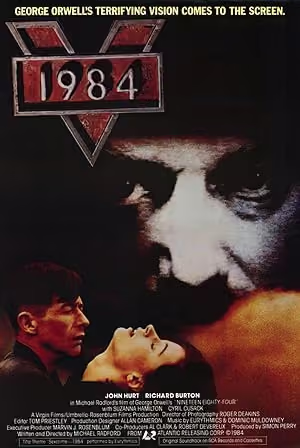
The core scenario of a totalitarian surveillance state grinding its population into submission is far from fantastical. History offers concrete precedent in Stalinist Russia, Maoist China, East Germany's Stasi, and North Korea today. Mass surveillance, informant networks, propaganda ministries, and the rewriting of history are all documented realities. What pushes the film slightly short of a perfect score is the totality of Oceania's control, a near-flawless apparatus that real regimes have never quite achieved because human systems always leak. Still, with modern digital tracking, facial recognition, and data harvesting, the technological path toward Orwell's world is more plausible now than when the book was written.
The film is grim, deliberate, and psychologically honest. Winston's fear, his small acts of rebellion, and his eventual breaking under torture all track with how people actually behave under sustained coercion and deprivation. The washed-out production design, the constant hunger, the shabby rationed goods, and the exhaustion of living under observation feel lived-in rather than stylized. Where it stays firmly grounded is in its refusal to offer a heroic escape. Winston does not outwit the state, and that bleak consistency is exactly how such systems tend to resolve for the average dissident. The only slight abstraction is how absolute and error-free the surveillance is, but the human reactions are entirely believable.
This is not a tactical survival film, so do not expect skills like water purification or shelter building. Its value to a prepper is conceptual and arguably more important: it teaches operational security, the danger of trusting the wrong people, the reality of informant networks, and how a population is conditioned into compliance through scarcity, fear, and information control. The lessons about keeping genuine thoughts private, recognizing propaganda, and understanding that surveillance erodes freedom before any shot is fired are all actionable in a broad sense. It falls short of a top score only because it offers awareness rather than concrete, repeatable procedures.


