


2012 is Roland Emmerich operating at maximum destruction, a two and a half hour demolition reel where the whole planet is the set piece. From a pure disaster spectacle standpoint it delivers exactly what it promises: crumbling cities, sinking continents, and improbable escapes rendered with enormous budget. As entertainment it is loud, expensive, and occasionally breathtaking. As a preparedness study it is close to useless, because nothing on screen resembles a threat you can actually plan for.
For the self-reliant viewer, the frustration is that every survival in the film comes down to luck, wealth, or a friend on the inside who happens to have a ticket to an ark. There is no bug out bag, no water plan, no shelter strategy, no community cooperation that a prepper could take home and apply. The one honest theme is that governments may hide catastrophic information and that only the connected and the rich get seats in the lifeboat, which is a cynical but worthwhile reminder that you cannot count on being rescued.
Watch it for the popcorn and the effects, not for the lessons. If you want a film that respects geology or human behavior, look elsewhere, but if you want to see the end of the world staged with unapologetic excess, 2012 scratches that itch. Just do not mistake any of it for a blueprint. The real preparedness takeaway is simply this: have a way to move your family fast, keep some resources ready, and never assume the authorities will tell you the truth in time.
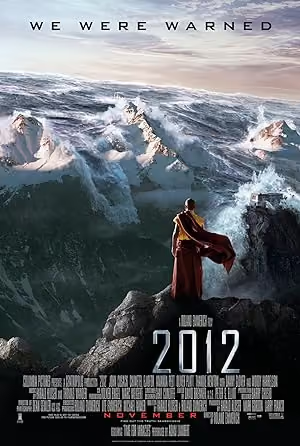
The film's central premise rests on a scientifically discredited chain of events. Neutrinos from solar activity do not mutate into particles that superheat the earth's core, and the crust does not slip catastrophically over a matter of days. Real geological processes unfold over millions of years, and while earthquakes, tsunamis, and eruptions are genuine hazards, a synchronized global crustal displacement wiping out civilization within hours belongs to fantasy. The scenario is effectively impossible as depicted, which anchors the possibility score at the bottom of the scale.
The physics is nonsense and the human behavior is worse. Characters outrun collapsing freeways, fissures, and pyroclastic clouds by seconds with impossible regularity, and a single limousine repeatedly threads through a disintegrating city that should have killed everyone instantly. Government continuity planning is reduced to secret arks funded by billionaires, which is more spectacle than serious policy. The emotional beats are formulaic and the survival is driven by luck and plot armor rather than any believable competence, so events and reactions rarely track how real people or systems would respond.
There is very little actionable preparedness value here. The disaster is too fast, too total, and too fictional to model any realistic plan against. About the only faint takeaways are the value of early insider information, having a plan to reunite and evacuate your family, keeping transportation and cash ready, and understanding that officials may withhold bad news to prevent panic. None of these are taught with any rigor, and the film offers no usable lessons on shelter, supplies, or genuine hazard response.


