


Blood Quantum is a zombie film with far more on its mind than gore, though it delivers plenty of that too. Director Jeff Barnaby uses the outbreak framework as a vehicle for a scathing look at colonialism and Indigenous survival, and the result is smarter and angrier than most entries in the genre. For a viewer who watches these films purely as escapism, the heavy allegory may feel like ballast, but it also grounds the human drama in something that resonates beyond the usual splatter.
From a preparedness standpoint, the film's strongest material is its treatment of the gate question: what a community owes to outsiders, and what letting them in costs. The Mi'gmaq reserve becomes a case study in the eternal tension between compassion and security, and the paranoia, resource strain, and internal splintering that follow are portrayed with real honesty. The scenario is biologically impossible and the film never pretends otherwise, so no one should mine it for survival science. What it offers instead is a meditation on group dynamics, defensible ground, and the reality that a community usually falls from within before it falls from without.
Is it worth watching? For a self-reliant viewer interested in the sociology of collapse and the ethics of who gets through the gate, yes. It rewards attention with a strong ensemble, a distinctive visual style, and a genuinely unsettling portrait of a group under pressure. Just do not expect a field manual. Study it for mindset, leadership, and the human cost of hard choices, not for tactics, and it earns its place on the shelf.
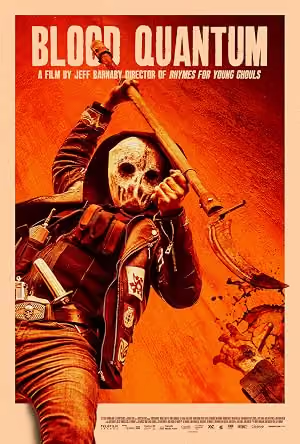
The core premise, a reanimating zombie plague to which a single Indigenous community holds genetic immunity, has no basis in biology or real-world epidemiology. Dead tissue cannot be reanimated to attack the living, and no pathogen confers survival based on ancestry or blood quantum in the manner depicted. This is pure genre fantasy built for allegorical purposes rather than plausibility, so the scenario itself is effectively impossible.
While the outbreak itself is fantastical, the human element is handled with real credibility. The film gets the social dynamics right: the paranoia, the agonizing debate over admitting outsiders, the way scarcity and fear fracture a tight community from within, and the reality that internal conflict often kills more surely than the external threat. Characters behave with recognizable motivations, grief, and moral fatigue rather than as cartoon heroes. The choice to fortify a defensible, isolated location and the friction between compassion and self-preservation reflect how people genuinely respond under siege, which lifts the realism well above the impossible premise.
The takeaways are thematic more than tactical. There are useful lessons about the value of a defensible and isolated location, the danger of admitting unvetted outsiders, the need for quarantine and screening protocols before letting refugees inside a perimeter, and the way group cohesion and leadership determine survival more than any weapon. The film also illustrates that internal betrayal and complacency erode security faster than the outside threat. However, it offers little concrete instruction on logistics, supply management, sanitation, or medical response, so a prepper gains mindset and community lessons rather than a practical playbook.


