


Equilibrium is a stylish dystopian action film that borrows heavily from Fahrenheit 451, 1984, and Brave New World, then wraps the ideas in slick gunfights and Christian Bale's committed lead performance. From a prepper's chair, the value here is philosophical rather than practical. The film asks a question worth sitting with: what would you trade away for the promise of peace and stability, and who benefits when a population agrees to feel nothing and question nothing?
The trouble is that the movie is far more interested in choreography than consequence. The gun kata sequences are undeniably fun to watch, but they push the story into pure fantasy, where one awakened man dismantles a totalitarian state almost single handedly. That is not how repression, resistance, or systemic collapse actually works, and viewers looking for realistic lessons in organizing, evading surveillance, or surviving under an authoritarian regime will find only broad strokes. The world is a mood board, not a blueprint.
Still, it is worth watching once for the underlying warning. The idea of mandatory medication, banned culture, and a state that trades freedom for the illusion of safety resonates with anyone who prizes self-reliance and personal autonomy. Enjoy it as a cautionary parable and a well-crafted action piece, but do not mistake it for a survival guide. The takeaways are about mindset and liberty, not skills you can drill.
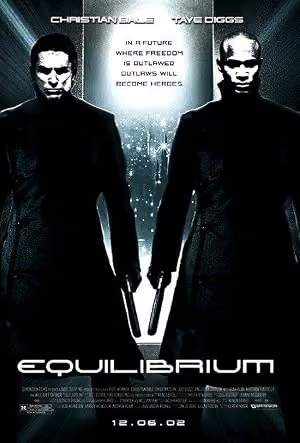
The film's core premise, a state that eliminates war by chemically suppressing all human emotion across an entire population, is far outside real-world possibility. While authoritarian regimes have historically banned books, art, and dissent, and forced medication has occurred in isolated abusive settings, the mass daily dosing of a whole society with a perfect emotion-blocking drug that everyone reliably takes is a fantasy construct. The precision and universality required simply do not exist. The individual elements of censorship and repression have precedent, but the unifying mechanism does not.
The film gets the atmosphere of a controlled surveillance state reasonably right, including informants, ritualized executions, and the sterile architecture of authoritarian power. However, the behavior strains credibility once the action begins. The invented martial art of gun kata, where the hero mows down dozens of trained soldiers unscathed, abandons any pretense of realism. Human reactions to emotional reawakening are handled with some sensitivity, but the ease with which a single agent topples the entire regime undercuts believability. It is a stylized parable rather than a grounded depiction of resistance.
The practical preparedness takeaways are thin. The most useful lesson is thematic rather than tactical: the danger of surrendering autonomy, whether through mandatory medication, censorship, or blind trust in a centralized authority that promises safety in exchange for control. Preppers value independence and skepticism of overreaching systems, and the film dramatizes why. Beyond that broad warning, there is little actionable content. There are no survival skills, no resource management, no realistic resistance tradecraft to study. It functions as a cautionary tale about liberty, not a manual.


