


I Am Legend is a lonely, atmospheric picture that will resonate with anyone who has thought seriously about what surviving alone actually looks like. Will Smith carries almost the entire film, and his portrayal of a man clinging to structure and purpose in an empty city is where the movie earns its keep for a prepper audience. The empty New York is a haunting reminder of how fast infrastructure and society can vanish, and how a single disciplined person adapts to fill the silence.
From a preparedness standpoint the first two acts are the valuable ones. Neville's fortified home, his generator and fuel management, his gardening, his scavenging runs timed around daylight, and his reliance on his dog all reflect sound survival thinking. The film is honest about the mental cost of isolation, which is a threat many preppers underestimate. Where it stumbles is the shift into monster-movie territory, where the infected become supernatural and the careful logic of the early scenes gives way to action set pieces and emotionally driven blunders that a disciplined survivor would avoid.
Worth watching, with realistic expectations. Treat the first hour as a study in solo survival, routine, and home defense, and treat the creature elements as entertainment rather than instruction. The scenario is more fiction than forecast, but the human portrait of endurance, loneliness, and the drive to keep broadcasting hope is genuinely useful to think through before you ever need it.
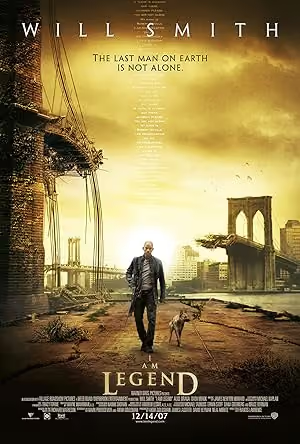
The core premise begins from a plausible seed, a man-made virus escaping control, which has real historical anxieties behind it in the form of gain-of-function research and engineered pathogens. Where the scenario departs from reality is the transformation of the infected into fast, physically mutated nocturnal creatures with altered biology. A pathogen that kills or incapacitates most of humanity is within the realm of the possible, but one that reshapes hosts into hairless, super-strong predators sensitive to sunlight belongs to fiction. The realistic pandemic foundation earns it some credit, while the monster biology pulls the plausibility down sharply.
The film gets several human details right. Neville's rigid daily routine, his radio broadcasts to seek other survivors, his use of a dog for companionship and early warning, and the slow psychological erosion of prolonged isolation are all believable and well portrayed. His scientific persistence and the empty, overgrown city are effective and grounded. However, the behavior of the infected as coordinated, rage-driven mobs and some of Neville's tactical mistakes, particularly abandoning caution when emotionally compromised, stretch believability. The depiction of loneliness and mental decline is the strongest realistic element, while the creature mechanics and a few plot conveniences drag the grounding down to the middle.
There are real takeaways here for the self-reliant viewer. Neville models the value of a fixed daily routine to preserve sanity, securing and fortifying a defensible home base, maintaining a food and fuel supply through scavenging and gardening, keeping a working vehicle, and using a dog as both an early-warning system and morale support. His radio outreach shows the importance of communications planning for finding other survivors. The counter-lessons are equally instructive: never let emotion override your security discipline, always have an exit plan, and do not overextend after dark. The lessons on solitude, routine, and home defense carry genuine weight, even if the fantastical enemy limits direct application.


