


Into the Wild is one of the most quietly instructive survival films a prepper can watch, precisely because it is a true account of failure rather than a fantasy of triumph. Sean Penn treats McCandless with sympathy, but the facts speak for themselves. A bright young man walked into the Alaskan interior with a rifle, a bag of rice, and a head full of ideals, and he did not walk out. For anyone who romanticizes bugging out to the wilderness, this is required viewing.
What makes the film valuable is how clearly it exposes the gap between the desire to live off the land and the skills required to actually do it. McCandless had courage and heart but lacked the boring fundamentals: caloric planning, food preservation, plant identification, navigation, and a communication or extraction plan. The infamous river that trapped him had a crossing he never knew about because he refused to carry a map. That single detail is worth more than a dozen action movies about the apocalypse.
The pacing is slow and the tone is meditative, so viewers wanting tactical thrills should look elsewhere. But as a case study, it earns its place. Watch it, then sit down and honestly ask whether your own wilderness plan is built on knowledge and redundancy or merely on hope. McCandless proved that the land does not grade on intention. It is a sobering, beautifully made cautionary tale, and every self-reliant person should absorb its lessons.
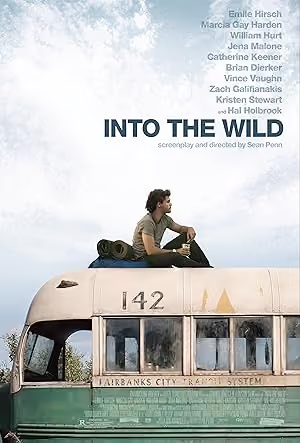
This is not merely possible, it actually happened. Christopher McCandless really did venture into the Alaskan bush with minimal gear and died there in 1992. Every year people underestimate wilderness, run short on food, misjudge weather, and become trapped by seasonal river swells. The scenario is as real as it gets, drawn directly from a documented death and the reporting of Jon Krakauer.
The film is grounded and honest about consequences. It shows the slow erosion of a man who is intelligent and passionate but critically underprepared. His euphoria masks poor planning, no map, insufficient calories, and no exit strategy once the Teklanika River rose and cut off his return. The behavior rings true because it mirrors how real people talk themselves into risk. The only softening is the romantic, meditative tone, but the film never pretends the ending is anything but tragic and avoidable.
There is enormous instructional value here, mostly as a catalog of what not to do. McCandless carried no detailed maps, so he did not know a hand tram crossed the river a short distance away. He relied on foraging without solid botanical knowledge, likely poisoning himself or starving on inadequate nutrition. He told almost no one his exact plans and had no communication device or resupply. Every one of these failures is a concrete lesson: know your terrain, master food procurement before you need it, carry navigation, and always keep a way out.


