


Jungle is a survival drama grounded in the real ordeal of Yossi Ghinsberg, and that authenticity is exactly what makes it worth a prepper's time. Daniel Radcliffe carries the descent from eager backpacker to gaunt, half-broken survivor with conviction, and director Greg McLean resists the urge to turn the Amazon into a video game of set-piece dangers. Instead the real enemy is slow: bad decisions, dwindling food, wet rot, isolation, and a mind that starts to turn on itself.
From a self-reliance standpoint the film is a case study in how catastrophe is usually built long before the crisis moment. The group's undoing begins in La Paz, when they trust a stranger's story of gold and lost tribes, and continues when they ignore friction, press deeper than their experience allows, and finally separate. Every prepper preaches planning, redundancy, and not overextending, and this film shows the human cost of ignoring all three. Watching Yossi ration hope as much as calories is a useful reminder that morale management is a survival skill, not a soft one.
It is not a how-to manual, and the last act leans on the raw endurance of one man more than on repeatable technique, so do not expect a bushcraft tutorial. But as a study of judgment, group dynamics, and the psychology of being truly alone and lost, it earns its high marks. For anyone who ventures into remote country, or who wants to understand how ordinary trips become life-and-death events, Jungle is a sobering and genuinely instructive watch.
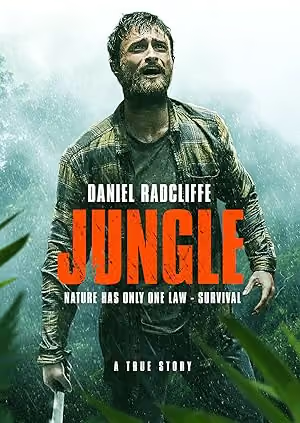
This is a dramatization of the true story of Yossi Ghinsberg, who survived roughly three weeks alone in the Bolivian Amazon in 1981. Getting lost in remote wilderness, being separated from your party, and having to survive alone is not just possible but happens regularly to hikers, backpackers, and adventure travelers around the world. The scenario carries direct historical precedent because it actually occurred, which places it near the top of the possibility scale.
Because it is based on a real account, the film gets the fundamentals right. The group's cascade of small mistakes, following a charismatic stranger with vague credentials, splitting the party over a disagreement, attempting to raft an unfamiliar river, feels painfully authentic. Yossi's physical and mental decline, including hallucinations from starvation and the toll of foot infections and insect exposure, tracks with how the human body actually breaks down. The film does compress and stylize some suffering for drama, and a few survival moments feel cinematic, but overall human behavior and consequences are believable and grounded.
There is a great deal a prepper can extract here. The strongest lesson is upstream of the disaster: vet your guides, verify plans, do not commit to a remote expedition on the word of a stranger, and never split the group in unfamiliar terrain. Once stranded, the film illustrates the value of staying put versus moving, following water downstream, protecting your feet, managing morale and hallucination, and the deadly speed of infection and malnutrition in the tropics. It also quietly shows how a signal, luck, and persistence factor into rescue. The takeaways are specific and actionable rather than abstract.


