


Miracle Mile is a tense, claustrophobic little thriller that trades special effects for mounting dread, and for a prepper it works as a real time case study in what happens when ordinary people receive the worst possible news with no plan in place. The entire film unfolds over roughly one hour of screen time in a single Los Angeles neighborhood, which forces you to feel the compression of a thirty minute missile window and the impossibility of doing much once the clock starts.
What makes it valuable is not any tactical wisdom the characters display, because they have almost none. Instead it is a mirror held up to unprepared humanity. The protagonist hears the warning and immediately chases love instead of survival, the crowds clog every road the instant panic spreads, and the few who try to act rationally are drowned out by disbelief and hysteria. Every mistake on screen is a checklist item for the viewer to correct in their own planning: verify your intelligence, know your exit before the emergency, pre position your resources, and decide in advance what and who you are moving toward.
It is worth watching, both as a genuinely gripping piece of Cold War cinema and as a sobering reminder that in a fast moving nuclear scenario, hesitation and improvisation are fatal. The film will not teach you shelter construction or fallout timing, but it will burn into you the emotional truth that the time to prepare is long before the phone rings. For a prepper, that lesson alone justifies the eighty seven minutes.
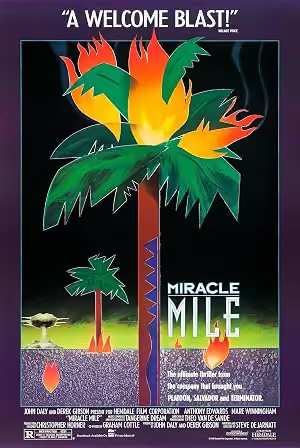
During the Cold War, a nuclear exchange between the United States and the Soviet Union was a genuine and studied threat, complete with real launch protocols, missile warning systems, and mutual assured destruction doctrine. The film's premise of an accidental or escalating strike unfolding within a short warning window reflects the very real thirty minute intercontinental ballistic missile flight times of the era. While the specific chain of events here begins with a fluke overheard phone call, the underlying scenario of imminent nuclear conflict had solid real world precedent and remains possible in any period of major power tension.
The film gets the human response strikingly right. When the protagonist tries to warn others, he is met with disbelief, then partial belief, then chaos, which mirrors how rumors and panic actually propagate when information cannot be verified. The escalating gridlock, the looting, the desperate scramble for helicopters and fuel, and the paralysis of people who simply cannot process the news all ring true. Where it strains is in the single lucky phone call driving everything and the compressed romantic urgency, but the crowd behavior and the collapse of order within a single hour are believable and unsettling.
The strongest lesson is about warning verification and the danger of acting on unconfirmed information, in either direction. The protagonist wastes precious time chasing a girlfriend instead of moving toward survival, a vivid illustration of how emotional attachment can override rational escape planning. Preppers can study the film's depiction of instant gridlock as proof that any evacuation must begin before the masses move, and that pre staged transport, fuel, and a rally point matter enormously. The absence of any fallout shelter plan and the characters' total lack of preparation are themselves instructive as cautionary examples.


