


Testament is not an action film, and preppers expecting bunkers, firefights, or last minute heroics should adjust their expectations. This is a quiet, devastating domestic drama about an ordinary suburban family in the days and weeks after a nuclear attack severs their town from the rest of the country. The horror comes not from the blast, which is never shown in detail, but from the slow realization that no help is coming, that the children are getting sick, and that the world they knew is simply gone. It is one of the most emotionally honest depictions of catastrophe ever put on screen.
From a self reliance standpoint, the film functions as a stark warning about the cost of being unprepared. The community in Testament has no plan, no shelter, no radiation detection, and no stored supplies to speak of, and we watch the consequences unfold with unflinching realism. That is the value here. It shows exactly what happens to normal people who assumed the worst could never touch them. Watching it should reinforce the case for potassium iodide, sealed food and water reserves, sanitation planning, independent communication gear, and above all a family that has talked through what to do before disaster strikes.
This is a worthwhile watch for any serious prepper, though it is emotionally heavy and offers inspiration through absence rather than instruction. You will not learn a single survival skill from these characters, but you will feel, in your gut, why the skills matter. Testament earns its place as a sobering reminder that preparedness is ultimately about protecting the people you love, and that the time to act is long before the sirens sound.
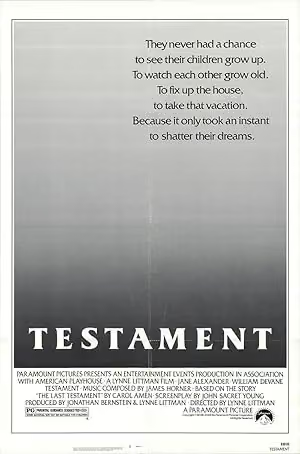
A nuclear exchange affecting the United States remains a genuine real-world possibility, grounded in decades of Cold War history and the ongoing existence of large nuclear arsenals. The film wisely portrays the aftermath in a suburban town well outside the primary blast zone, which is exactly the kind of place that would survive the initial detonation only to face fallout, isolation, and slow decline. While the scale of full nuclear war has thankfully never been realized, the underlying scenario has real precedent in weapons testing, Hiroshima, and Nagasaki, and the threat has not vanished. This is one of the more plausible catastrophe premises in cinema.
Testament is remarkable precisely because it refuses spectacle. There is no mushroom cloud set piece, no heroic rescue, no clear enemy. Instead the film shows the quiet, grinding reality of a community cut off from the outside world, watching radiation sickness claim children one by one. The behavior of the characters rings true: initial disbelief, attempts to maintain normal routines, rationing, the slow erosion of hope, and the desperate need to bury the dead with some dignity. The gradual breakdown of order, the failure of information to arrive, and the emotional toll on a mother trying to hold her family together are portrayed with painful honesty. Few films capture the psychological dimension of prolonged crisis this accurately.
The practical, hands on preparedness lessons here are modest because the film is deliberately about helplessness rather than tactics. Still, a thoughtful prepper takes away several concrete points: the danger of having no independent communication or radiation monitoring, the speed at which food and medicine run out when supply chains die, the importance of sanitation and body disposal to prevent disease, and the devastating effect of fallout on those with no shelter or potassium iodide. Most of all it teaches the value of community cohesion and mental resilience. What it does not offer is a roadmap for survival, since almost no one prepared, and that absence is itself the lesson.


