


The Purge markets itself as a home invasion thriller wrapped in political allegory, and from a preparedness standpoint it functions best as a cautionary tale of what not to do. James Sandin has made a fortune installing security systems for his gated neighborhood, yet when the annual lockdown arrives his own home defenses prove almost decorative. The steel shutters look impressive but there is no redundancy, no safe room, no rally point, and no discipline among family members. It is a masterclass in confusing expensive gear with actual security.
The scenario itself is pure fiction and asks the viewer to accept a government that legally suspends all law and medical aid for twelve hours a year. Preppers looking for a plausible collapse study will not find it here, and the realism suffers further from characters making baffling choices, chief among them a child who deactivates the family's protection to let a stranger inside. That single act drives the plot but also perfectly demonstrates that the human element is the weakest link in any defensive plan, a point worth remembering even if the film delivers it clumsily.
Is it worth watching? As entertainment it moves quickly at a tight eighty five minutes, and there is value in analyzing the family's mistakes as a training exercise in what happens when planning is shallow and complacency sets in. Just do not mistake it for a serious survival resource. Watch it, critique the Sandins ruthlessly, and use their failures to pressure test your own home defense and lockdown procedures. The film earns its place as a conversation starter, not a manual.
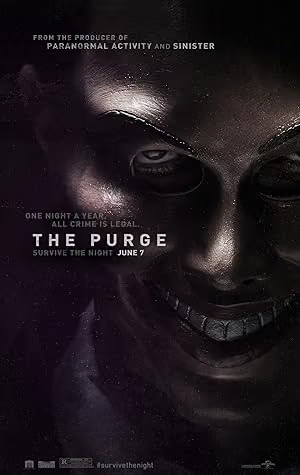
The core premise, a government legally sanctioning all crime including murder for twelve hours annually as a pressure valve for society, is essentially a fantastical thought experiment rather than a real-world possibility. No functioning state could suspend all law and emergency services on a scheduled basis without immediate economic and social ruin, and the notion that violence could be neatly switched off at dawn ignores everything we know about human conflict. While civil unrest, riots, and periods where police are overwhelmed absolutely have precedent, the specific mechanism of a legally mandated purge remains pure allegory.
The film gets a few things right about human behavior under threat, particularly how quickly a comfortable suburban family fractures under pressure and how thin the veneer of civility can be. However, most of the events strain belief. The Sandin family, whose wealth is built on selling security systems, has a laughably inadequate plan, no safe room worth the name, poor situational awareness, and a son who sabotages the entire lockdown on a whim. The armed intruders behave like theatrical villains rather than real attackers, and the tactical decisions on both sides serve drama over logic. The consequence-free reset at sunrise also undercuts any serious treatment of trauma or aftermath.
There are modest takeaways buried in the spectacle. The film illustrates that a security system is only as strong as the people using it, that hardened defenses mean nothing if an occupant opens the door, and that a fortified home can become a trap without escape routes or a genuine safe room. It also demonstrates the danger of complacency and of assuming money equals safety. A prepper can extract lessons on operational discipline, controlling entry points, family communication, and rehearsing a lockdown plan, but these lessons come mostly from watching the characters fail rather than from any competent modeling of preparedness.


