


V for Vendetta is a stylish, politically charged thriller that will resonate with any prepper whose motivation stems from distrust of centralized power. Adapted from Alan Moore's graphic novel, it imagines a Britain governed by the fascist Norsefire party, where curfews, surveillance, and a captive media keep a frightened population in line. For the self-reliant viewer, the film's real value is its portrait of how a free society can be talked and frightened into surrendering its freedoms one crisis at a time. That theme alone makes it worth an evening.
As entertainment it delivers, with Hugo Weaving giving a remarkably expressive performance from behind an unmoving mask and Natalie Portman anchoring the emotional core. From a preparedness standpoint, though, temper your expectations. V is a fantasy figure, effectively invincible, and the film's finale trades realism for spectacle. You will not learn how to store food, secure a retreat, or evade a real security service by studying his methods. What you will absorb is the psychology of an authoritarian state and the importance of guarding information and maintaining personal resolve, embodied in Evey's grim transformation.
Treat this one as a philosophical primer rather than a field manual. It scores respectably on plausibility because the slow death of liberty it depicts has genuine historical echoes, but its educational payoff is thin on actionable skills. Watch it to sharpen your awareness of how tyranny takes root and to reflect on why self-reliance matters, then get your practical knowledge elsewhere. Recommended for the mindset, not the tactics.
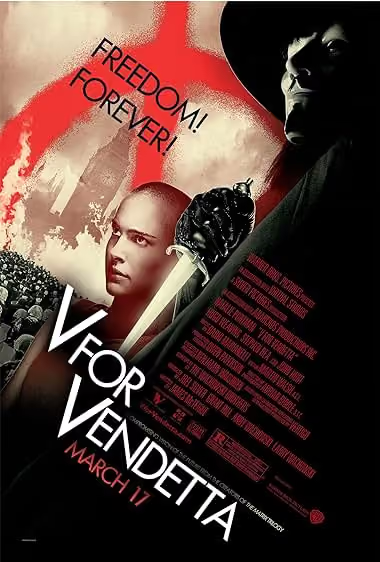
The film's core scenario, a democratic nation sliding into authoritarianism through fear, crisis, and a compliant media, is far from impossible and has real historical precedent in the twentieth century. The specific device of a government engineering a bioterror attack on its own citizens to consolidate power is speculative but not fantastical, as false flag operations and manufactured crises are documented historical tactics. The near-future setting keeps the technology and social conditions recognizable. Where it strains credibility is the near-total, cartoonishly efficient control the Norsefire party achieves, but the underlying process of democratic backsliding earns this a solid mid-to-high score.
V for Vendetta gets the mechanics of soft tyranny largely right: the role of state media, curfews, informants, secret police vans, and the slow normalization of fear are all portrayed convincingly. The population's passive compliance until a tipping point is believable. Where realism falters is in V himself, a nearly superhuman figure who survives explosions, dodges bullets, and executes elaborate plans without failure, which pushes the film into comic-book territory. The climactic image of an entire city donning masks and marching unopposed is stirring but ignores how a real security state would respond with lethal force. The human and institutional behavior is a mix of grounded and stylized.
The practical prepper takeaways are more conceptual than tactical. The film illustrates how liberties erode incrementally, why controlling information matters, and how fear is weaponized to justify control, which is valuable situational awareness. V's year of stockpiling, his hidden underground redoubt full of supplies and cultural artifacts, and Evey's forced resilience training touch on the value of a secure cache and mental toughness. However, there are few concrete, replicable skills here: no realistic security procedures, food storage guidance, or survival techniques a viewer could actually apply. It is a film about ideas and vigilance rather than hands-on preparedness.


