


WarGames holds up as one of the smartest doomsday films of its era precisely because it treats nuclear war as a systems problem rather than an action set piece. Matthew Broderick's curious teenager is the hook, but the real subject is a nation that handed too much authority to a machine and then discovered it could not easily take that authority back. For a prepper, that framing is the payoff: the threat here is not a mushroom cloud that appears from nowhere, it is a chain of small technical and procedural failures that nearly ends the world.
The pacing is deliberate and the tension is earned. The film respects the intelligence of its audience, showing officials wrestling with incomplete information and the agonizing question of whether an incoming attack is real. That mirrors the genuine fog that surrounds command decisions during a crisis, and it is a valuable reminder that the people at the top do not have perfect information any more than the rest of us do. The dated computing and the improbably easy break in are forgivable given how much the movie gets right about escalation and the psychology of deterrence.
Is it worth watching for a self reliant viewer? Yes, though for perspective rather than a checklist. You will not walk away with new bushcraft or a bug out plan, but you will come away with a sharper appreciation for how automation, complexity, and human error combine to create catastrophic risk. The closing lesson, that some games are not worth playing, is exactly the kind of clear thinking a prepper should carry into every worst case scenario. A worthwhile and thought provoking watch.
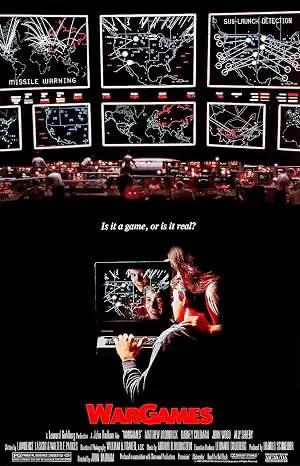
The core premise, that automated systems controlling nuclear weapons could misinterpret a simulation as a real threat and push the world toward launch, is not fantasy. During the Cold War there were genuine false alarms triggered by faulty chips, radar echoes, and training tapes loaded into live systems. The specific idea of a lone teenager dialing into NORAD is dramatized and simplified, but the underlying danger of over automation and inadequate safeguards around launch authority is a documented real world concern. That grounding earns the scenario a solidly plausible score.
The film gets the human and institutional response largely right. Officials scramble, disagree, and struggle to distinguish a real attack from a glitch, which mirrors how command and control actually behaves under ambiguity. The famous conclusion, where the machine learns that the only winning move is not to play, captures the true logic of mutually assured destruction. Where realism slips is the ease of the intrusion and the convenient personal access to the system's designer, which compress and simplify a process that would be far messier. Still, the tension and the decision making feel believable rather than cartoonish.
The practical takeaways are more conceptual than tactical. A prepper will not learn shelter building or food storage here, but the film drives home the fragility of complex automated systems and the danger of removing human judgment from critical decisions. It reinforces the value of understanding the threat of nuclear conflict, the importance of skepticism toward single points of failure, and the reality that catastrophe can begin from a small unnoticed error. Those are useful mental models for anyone planning around large scale, low probability, high consequence events, even if the hands on lessons are thin.


