


Interstellar is a beautiful, ambitious film that opens with one of the more thoughtful doomsday setups in recent cinema. The dying-Earth prologue, with its endless dust, failing crops, and a society that has stopped looking outward, is the part that will resonate most with a preparedness-minded viewer. Nolan understands that civilization does not always collapse dramatically; sometimes it just runs out of margin and quietly lowers its expectations. That slow suffocation of options is genuinely unsettling and worth reflecting on.
Where the film leaves the prepper behind is the moment it leaves the atmosphere. Once the story becomes about wormholes, relativity, and fifth-dimensional bookshelves, the survival relevance evaporates. This is not a knock on the movie as entertainment, but there is no lesson to extract from a plot resolved by faster-than-light rescue and cosmic intervention. The self-reliant takeaways all live in the first act: guard your food supply, distrust fragile monoculture systems, keep your skills and equipment sharp, and protect your lungs when the air turns against you.
Worth watching? Absolutely, for its craft, its performances, and its sobering portrait of agricultural collapse and food insecurity. Just go in understanding that its value to a prepper is thematic rather than practical. It will make you think hard about the resilience of the systems you depend on, but it will not teach you how to survive when they fail. Study the dust, ignore the wormhole.
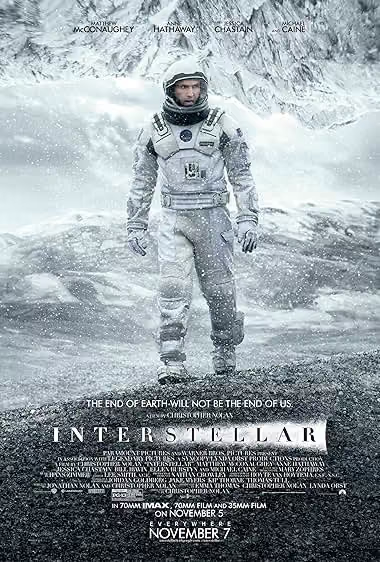
The film's foundational premise is more plausible than its cosmic third act suggests. A cascading crop blight that wipes out staple after staple, combined with worsening dust storms reminiscent of the 1930s Dust Bowl, is grounded in real agricultural and ecological risk. Monoculture farming, soil depletion, and plant pathogens are genuine vulnerabilities. The wormhole travel, tesseracts, and higher-dimensional beings are pure speculative fiction, but the slow-motion collapse of the food supply that drives everything is entirely conceivable. The scenario earns a mid-range score because the Earth-bound cause is realistic even if the interstellar solution is not.
Nolan gets the texture of decline right. Society does not end in a bang here but in a quiet, grinding retreat: schools rewrite history to discourage engineering, dust invades every home, and people simply accept a shrinking horizon. That depiction of managed decline and normalized scarcity is believable. Human reactions are mixed in credibility. Cooper's abandonment of his children for an uncertain mission, Dr. Mann's cowardice and sabotage under isolation, and Murph's lifelong resentment all ring true to how people actually behave under extreme stress. The science-fiction machinery and the tidy love-transcends-dimensions resolution strain believability, but the emotional and social realism is strong.
The practical preparedness lessons are limited and mostly incidental. Viewers can note the very real danger of monoculture dependence and single points of failure in the food system, the value of storing and sealing food against contamination, and the importance of dust and respiratory protection during storms. Cooper's home shows sensible habits: keeping vehicles and gear maintained, self-sufficiency in farming, and adaptability. Beyond that, the film offers little actionable technique, since the plot pivots to space travel that no prepper can replicate. It works better as a meditation on long-term systemic risk than as a how-to guide.


